
Questions about Parkva Patrol.
What enforcement operators, property managers, and agencies ask before Patrol goes on a vehicle.
Answers checked against the product on .
Parked at a property that uses Parkva? See help for residents and guests.
How it works
What is Parkva Patrol?
Parkva Patrol reads license plates from a moving vehicle and checks each one as it goes. Two infrared cameras ride on the vehicle your team already drives, one reading the cars on the left and one the cars on the right. Every plate is checked against the property’s permits, guest passes, and zones, and against your own hotlist, and the answer shows on a tablet beside the driver. Nobody walks the lot to read plates.
Who runs Parkva Patrol?
Tow operators, security operators, and parking enforcement operators run Patrol across the properties they serve, and law enforcement runs it on its own lists, in its own account. Cities and universities run it on the lots they manage, and a property’s own team can put it on a staff vehicle, a golf cart included.
Why read plates from a vehicle when a permit app can check them on a phone?
A phone check covers one car at a time: someone walks to it, points the phone, and waits for the answer. Across a full lot that’s hours on foot, often in the dark. Patrol reads plates from both sides as the vehicle drives: one pass covers the lot, and the driver gets out only when there’s work. FTR Inc: “If my drivers are walking, they might hit 3 or 4 properties in a shift. With Parkva, we can hit 20.” Patrol keeps a phone check too, for spots a vehicle can’t reach: the phone reads the plate from a photo and runs the same check, on the same patrol record.
How fast can Patrol check a lot?
Patrol reads more than 100 plates a minute, from both sides of the vehicle at once, and checks each plate as it reads it. Cedar Towing covers a complex of up to 2,000 vehicles across seven lots and reports clearing it in under an hour: “It used to take three or more.” That’s Cedar’s own result on its own properties, not a Parkva measurement. How long your lots take depends on their size, their layout, and how fast it’s safe to drive through them.
How accurate are Patrol’s plate reads?
Every read comes with its photo, so anyone can check the plate with their own eyes. The unit allows for a misread character. Before a ticket or a tow, the driver checks the plate again live, and if a plate on file is one character away from the one entered, Parkva lists both and asks which plate is really on the car. Cedar Towing, after moving its patrols to Parkva: “Mistaken tows are way down.”
Does Patrol read plates at night and in bad weather?
Yes. The cameras are infrared: they read plates after dark, and rain and snow don’t stop them. Cedar Towing runs Patrol through Minnesota winters: “I was skeptical about how it would perform in rain and our harsh Minnesota winters. But we’ve had zero issues.” The driver stays in the vehicle while the cameras read. Nobody walks the lot with a flashlight.
What happens when the vehicle loses signal?
Patrol keeps checking. When the driver starts at a property, its whole list loads onto the unit, and every plate is checked against it in the vehicle. A parking garage or a dead zone doesn’t stop the pass. Photos and reads go up to the record when the signal returns. If Parkva’s server ever has a hiccup while a list is loading, the unit keeps the last good list, not an empty one that would show residents’ cars as unpermitted.
Permits and each property’s rules
Which permit systems does Patrol check?
Parkva Permit is built in, and Patrol also checks the outside permit system each property already uses, with your own login, on the same pass. ParkMobile, Parking Boss, ParkM, and ParkingPass are among them, and the Patrol page shows the full set. One property can be linked to several systems at once, and each permit on the tablet shows which system it came from. A new property doesn’t have to switch apps before you start. Properties on Parkva Permit get more from the same pass, because residents and guests keep their cars current themselves.
Does Patrol work on lots with hang tags or stickers?
Yes. Patrol reads plates, not tags, and on a hang-tag lot it starts with Lot Memory. Sweep the lot once, mark the cars that belong, and every later pass, on any vehicle that covers the property, flags the cars that are new. You can also start from a spreadsheet of plates. When the property is ready to retire its tags, residents register their cars in Parkva Permit and the plate becomes the permit.
How does Patrol know each property’s rules?
It carries them. Each property’s permits, guest passes, zones, and Allow and Block Lists load onto the unit when the driver arrives, so a driver new to a property gets the same answer your most experienced driver would. The tablet shows where a permitted car belongs: its zone, in that zone’s own color, and its building, unit, and space. What happens next follows that property’s settings: whether a warning comes first, how long a notice runs, and whether tickets and tows are allowed there at all. On a phone, the check offers only the steps that property allows.
Re-checks, tickets, tows, and approvals
Does Patrol decide which cars get towed?
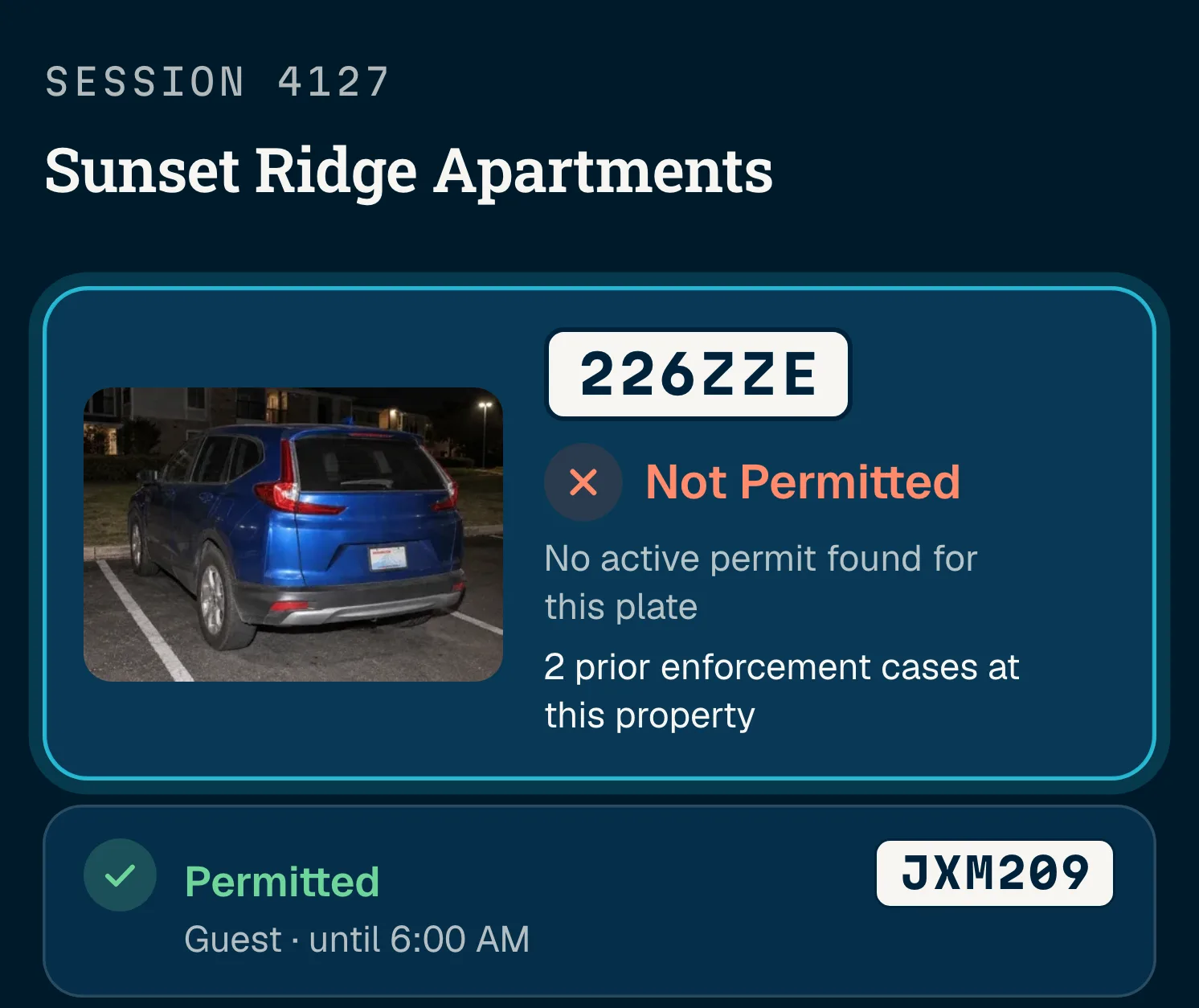
No. Reading and checking are automatic, and acting on a car is a person’s call. Patrol shows the driver the answer and the property’s record for the plate, and the driver decides what to do. Before anyone acts on a car that is permitted, Parkva asks them to confirm a separate violation, like a fire lane, and a car on the property’s Allow List takes a written reason, saved on the case. Every step lands on one case with its photos, so a question later is answered from what was recorded.
What does the driver check before a ticket or a tow?
One tap checks the plate again, live, and shows everything on file for it: a pass bought a minute ago, earlier warnings, unpaid tickets, the manager’s instructions, and the photos. A guest who paid two minutes ago shows as paid, and the driver moves on. If the car is still in the wrong, the re-check, the photos, and what was on file at that moment all stay on the case. When the property manager asks why, the answer is already written down.
Can a warning or a ticket come before a tow?
Yes, and each property has its own order. Its settings can call for a warning before a ticket, give a car one or more notices with their own countdowns, and allow tickets, tows, or both. A ticket prints in the vehicle in one tap, with your company’s name and its own code. The car’s driver scans the code and sees photos of their car on the page where they pay or appeal. If the car belongs to a resident, their notice waits an hour, for the officer’s safety, and never sends if the ticket is paid first.
How do re-checks on warned cars work?
When a warning is about to run out, the car shows at the top of the enforcement page, marked Expiring Soon. The driver goes back and records what they found: the car moved to a spot where it’s allowed, left the property, is still there, or needs the next notice, a ticket, or a tow, as that property allows. Each answer goes on the case with photos and notes. A warning also closes by itself when a later pass finds the car registered or parked where it may park.
Can a property manager approve tows before they happen?
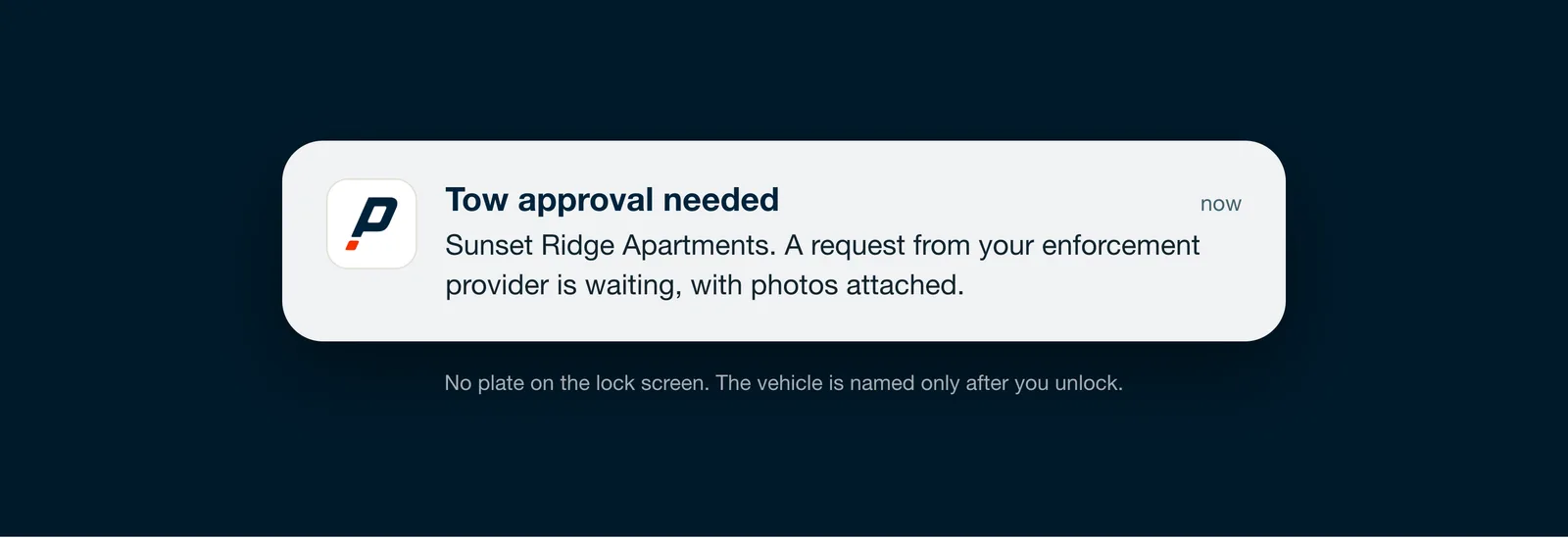
Yes, where the property wants it. Each property decides whether its tows need the manager’s approval. When they do, the request waits for the manager with the plate, the violation, the photos, and any earlier cases, and the manager approves or denies it in one tap, from a phone or a desk. If a plate on file is one character away from the requested one, the request shows both, beside the photos. If nobody answers within the window the enforcement operator set, the request closes and the car isn’t towed.
Does Patrol work with our tow dispatch software?
Yes. With Omadi, the tow request goes straight in, and any other dispatch gets it by email, Slack, or a phone call, with the plate, the car, where it’s parked, and the case number, so nobody calls the driver back to describe it. A tow driver on Parkva gets it as a new job, and where one company patrols and another company on Parkva tows, the tow passes to them on the same case, with the evidence attached.
Hotlists
What can go on a hotlist?
Any plate your team needs to know about: a stolen vehicle, a BOLO, or a car that’s trespassed or banned. An agency running Patrol in its own account also adds warrants and AMBER alerts. Add one by hand or import a spreadsheet, put it on every property you cover or just one, and write what the driver should do if it turns up. Every vehicle checks each plate it reads against the list, at every property an entry covers. A plate that owes more in unpaid tickets than the property allows goes on by itself and comes off when it’s paid. Property managers can flag a trespassed or banned car on their own Watch List, and hear when patrol sees it.
What happens when Patrol spots a hotlisted plate?
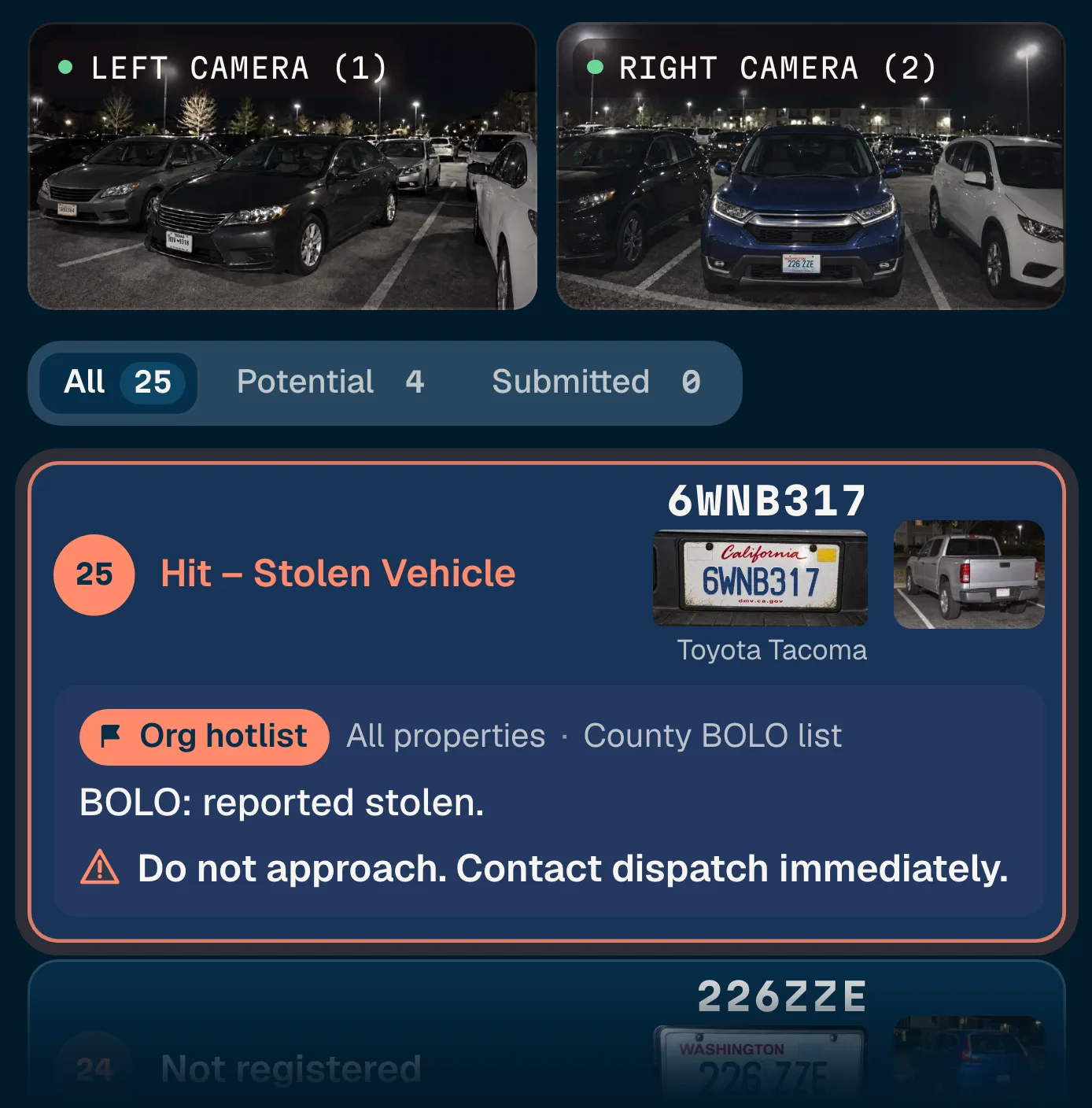
The driver sees the hit on the tablet with your instructions, like “Do not approach. Contact dispatch immediately.” The people you chose get an email with the plate, its category, photos of the plate and the car, the address, a map link, and the time. A car sitting still doesn’t flood the inbox: a repeat hit in the same spot within a few minutes isn’t sent again. Every sighting is kept in Hit History, with where and when the plate turned up.
Reports and records
How does a property manager know the lot was patrolled?
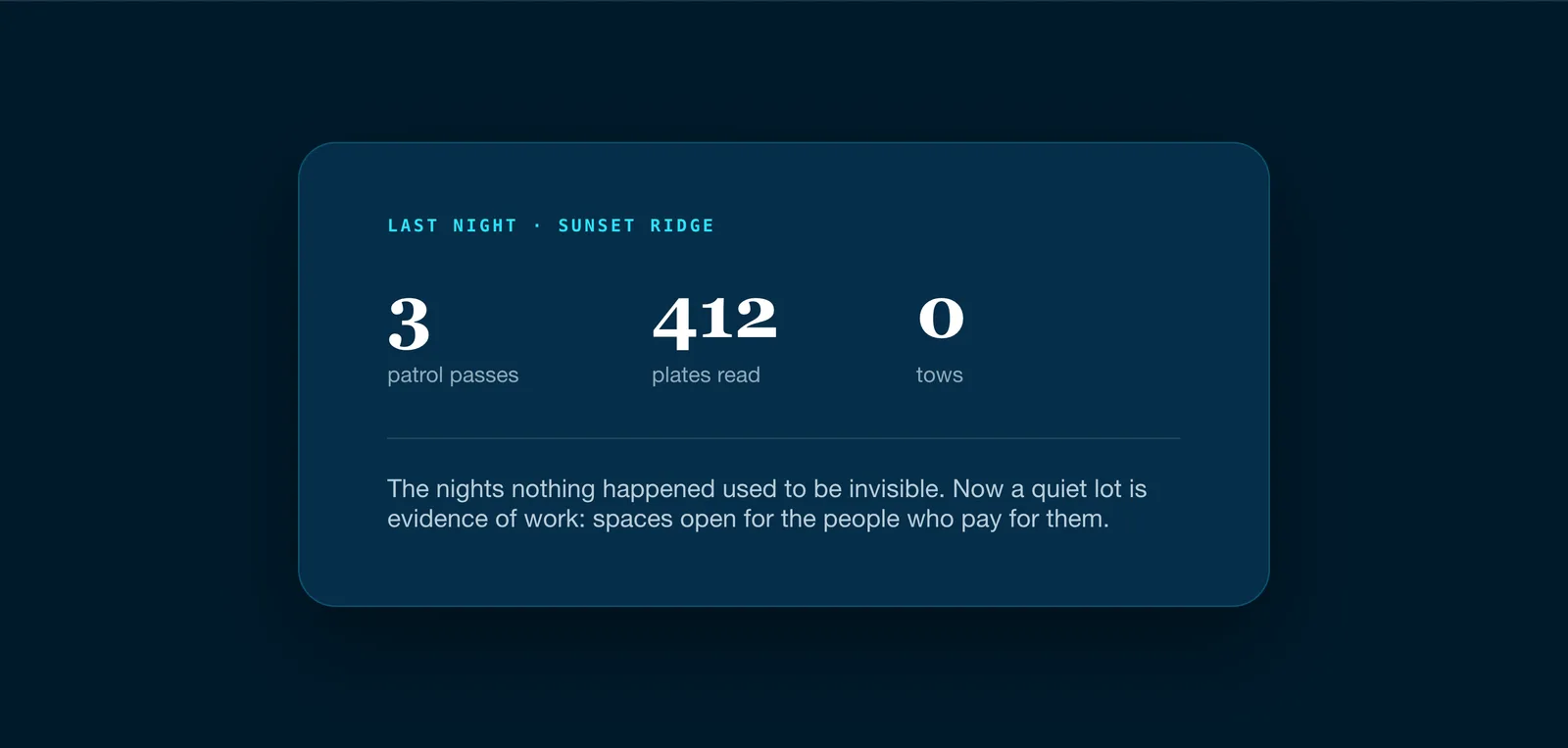
The enforcement operator can share Patrol Findings with the property. The manager then sees when the lot was last patrolled, how many patrols ran and how many plates were read in the last seven days, and which cars had no permit, with the patrol’s photos and a map link to where each was seen. A quiet night shows up as passes made and nothing to report. Every warning, ticket, and tow at the property, and how each one ended, is on its Enforcement page. On a property with Parkva Guard, each patrol also lands on that night’s security report.
The kit
What comes in the Patrol kit?
Two infrared cameras, a compact control unit, and a tablet for the driver, with a cup-holder mount, a power adapter, and everything needed to fit them. The control unit has its own cellular connection: there’s no hotspot or Wi-Fi to set up. An optional printer adds tickets printed in the vehicle. The tablet is locked to Patrol.
How does the kit go on a vehicle?
The cameras go on by magnet or a permanent bracket, one on each side, and the control unit runs on the vehicle’s power. Patrol starts when the vehicle does. The tablet fits a cup holder or the dash. Everything needed comes with it, and it goes on in under an hour. It runs on a tow truck, a security vehicle, a patrol car, or a golf cart, and when a vehicle is in the shop, the kit moves to another one.
How long does it take a driver to learn Patrol?
Minutes. The driver signs in at the start of a shift, the unit finds the property it’s on from its own location, and each plate comes back green or red, with a different sound for each permit type so eyes can stay on the lot. A new driver gets the same answer on night one as your most experienced one, because each property’s rules come with its list, and we help your team get going. Cedar Towing: “The system is solid. But the real standout? The support. Parkva’s people are fantastic.”
Next
Didn’t see your question?
Ask us, or book a demo and we’ll show you Patrol on a lot like yours.